I almost got fired from my first teaching job because I misunderstood what it meant to build relationships with students.
I knew relationships mattered, but I thought I built them through humor, conversations, and getting to know my students. I was young, enthusiastic, and determined to create a classroom where students felt connected, had fun, and wanted to be there. I worked hard to make that happen, but when it was time to learn, I expected everyone to flip a switch. Suddenly, the fun was over. I was the teacher, they were the students, and it was time to get serious.
It didn’t work very well. The friendly relationships we had during recess did not translate to cooperation when it was “time to get down to business.” I was baffled and frustrated, and my students knew it.
I cared deeply about my students. That wasn’t the problem. I learned the hard way that relationships and learning belong on the same team. I also had to let go of my frustration when students weren’t behaving the way I expected and recognize what they needed most from me: my presence, enthusiasm, and unwavering belief in them. They needed to feel my excitement about what we could accomplish together, not just through my words, but through my tone of voice, facial expressions, body language, and actions. My energy could spark theirs, and my belief in them could help them believe in themselves.
Today, most of my work is with educators, and I’ve learned that adults need these same things. When I am fully engaged, excited about the learning, and genuinely believe in the people in front of me, it makes a difference. Adults need to feel that the work matters and that I believe in their ability to grow. This has only deepened my appreciation for the teachers who create these experiences for students every day.
Throughout my career, I have had the privilege of watching remarkable educators connect with students in ways that transform their learning experiences. I’ve seen students move from disengagement and frustration to excitement, confidence, and pride in their accomplishments. A recent conversation with one of these teachers helped me put words to something I’ve observed in great classrooms for years: Relational Teaching.
Relational Teaching: A Working Definition
Relational Teaching is building relationships with students through the learning, not apart from it.
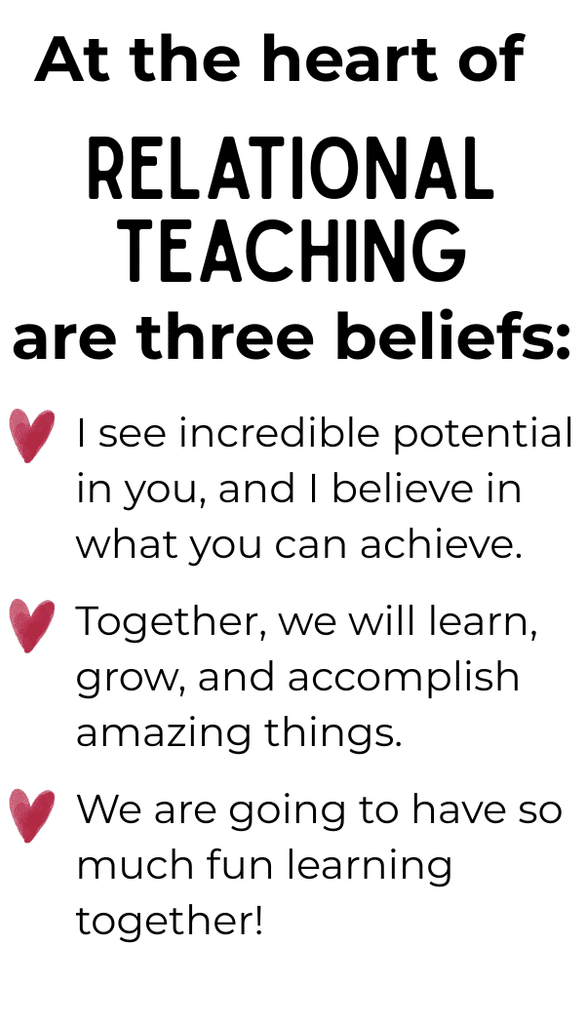
At the heart of Relational Teaching are three beliefs:
- I see incredible potential in you, and I believe in what you can achieve.
- Together, we will learn, grow, and accomplish amazing things.
- We are going to have so much fun learning together!
These beliefs become powerful when students can see, hear, and feel them in the way we teach every day.
The teachers I’ve learned from understand their students deeply, both as people and as learners. They know where students are right now and where they need to go next. They recognize the skills students already have and the ones they are developing. They pay attention to how students think, where they struggle, what gives them confidence, and what happens when learning gets hard.
Knowing that a student loves basketball matters. Knowing that the same student has incredible reasoning skills but shuts down when asked to explain their thinking in writing gives us another important way to connect. Both are essential parts of knowing the child.
These teachers also see strengths and possibilities in students that students don’t always see in themselves. They notice the writer, the mathematician, the leader, the problem-solver, the artist, the deep thinker, the person who keeps trying. And they make sure students notice those things too.
A teacher who says, “Look at how your thinking changed here,” or “You kept working even when that was really difficult,” is doing more than providing feedback. That teacher is helping a student develop a new understanding of who they are and what they are capable of.
Relational Teaching in Action
Relational Teaching doesn’t require us to add something else to our already full days. It invites us to be more intentional about the opportunities we have to connect with students through learning.
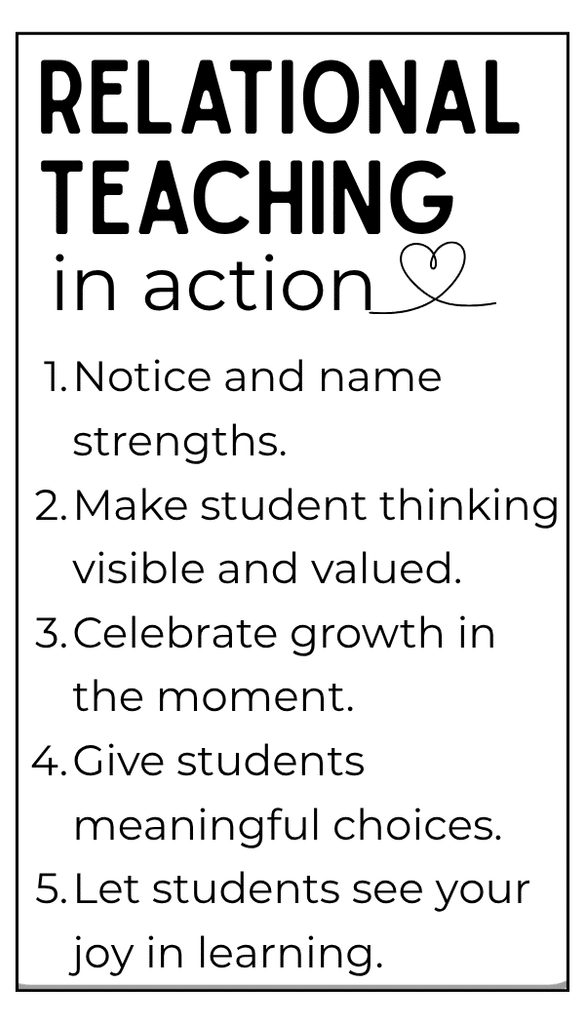
Here are a few ways to do that:
- Notice and name strengths. Look for opportunities to help students recognize something wonderful about themselves as learners. Be specific about what you notice: “The way you approached that problem shows how creatively you think.”
- Make student thinking visible and valued. Ask students to explain their thinking, share different approaches, and learn from one another. Show genuine curiosity about how they arrived at their answers, even when those answers aren’t correct yet. Approach students with positive assumptions, look for the strengths behind their struggles, and help them recognize what they already know and can do.
- Celebrate growth in the moment. Help students see how far they’ve come. Pull out an earlier writing sample, revisit a challenging skill, or point out a strategy they can now use independently. Make sure they identify the progress you see.
- Give students meaningful choices. Find opportunities for students to use their interests and strengths in their learning. Invite them to make decisions, take ownership, and discover what works for them as learners.
- Let students see your joy in learning. Bring your enthusiasm, curiosity, and sense of humor into lessons. Be willing to wonder, make mistakes, and learn alongside students. Let them see how much you enjoy the work you do together.
These moments may seem small, but they tell students something powerful: I see you as a learner. I value your thinking. I believe in what you can accomplish.
Building Relationships in Everyday Learning Moments
That belief also shows up in the instructional practices great teachers use every day. They adjust instruction when students aren’t learning. They collaborate with colleagues and try new approaches. They provide another opportunity when students need one. They give specific feedback that helps students take the next step. They hold high expectations while providing the support students need to reach them. Their actions communicate that they believe students can learn, and they are willing to keep learning themselves to make that happen.
Relationships grow when students collaborate to solve challenging problems, share their thinking, learn from mistakes, and celebrate accomplishments together. A classroom becomes a community when students experience the joy and satisfaction of learning alongside one another. These shared experiences help students develop confidence in themselves and trust in one another.
Of course, go to the baseball game. Ask about the weekend. Greet students at the door. Learn about their families. Laugh together. Find out what they love. Those things matter, and they are beautiful ways to show students that we care about them.
And there are even more opportunities to build meaningful relationships during a writing conference, while working through a difficult problem, through feedback on something a student worked hard to create, or in the moment when they finally accomplish something they weren’t sure they could do.
Relationships aren’t something we build so that eventually students will let us teach them. We build relationships while we teach them.
Helping Students See What’s Possible
Early in my career, I worked so hard to create a classroom where students liked me. What I’ve learned from the teachers I’ve admired most is that something even more powerful happens when we create classrooms where students begin to believe in themselves.
They discover strengths they didn’t know they had, accomplish things they once thought were impossible, and begin to imagine new possibilities for their futures. Through our daily interactions around learning, we communicate: I see you. I believe in you. And I’ll help you discover what’s possible.
I’ve watched students transform in classrooms where teachers recognize their potential and help them see it for themselves. The students haven’t become different people. They’ve begun to see themselves differently because of the way their teachers see them.
Building relationships is essential to learning, but how we build those relationships can transform what students believe is possible.
Reflect on Your Practices
As you reflect on your own students and discuss Relational Teaching with your team, consider these questions:
- Recognize what is working: Think about a student with whom you’ve built a particularly strong relationship through learning. What specific actions helped develop that relationship?
- Examine our practices: How do our instructional practices, feedback, and expectations communicate our belief in what students are capable of?
- Put it into action: What is one intentional action we can take this week to strengthen relationships with students through the learning?